
Case (![[personal profile]](https://www.dreamwidth.org/img/silk/identity/user.png) case) wrote in
case) wrote in ![[community profile]](https://www.dreamwidth.org/img/silk/identity/community.png) fandomsecrets2026-04-17 05:52 pm
fandomsecrets2026-04-17 05:52 pm
case) wrote in fandomsecrets2026-04-17 05:52 pm


[ SECRET POST #7042 ]
⌈ Secret Post #7042 ⌋
Warning: Some secrets are NOT worksafe and may contain SPOILERS.
Content warning type secrets today!
01. [WARNING for discussion of JKR/transphobia]

__________________________________________________
02. [WARNING for discussion of ableism]
__________________________________________________
03. [WARNING for discussion of JKR/transphobia]

__________________________________________________
04. [WARNING for discussion of dub/non-con]

__________________________________________________
05. [WARNING for discussion of JKR/transphobia]

__________________________________________________
06. [WARNING for discussion of pedophilia/CSA]

Notes:
Secrets Left to Post: 00 pages, 00 secrets from Secret Submission Post #1005.
Secrets Not Posted: [ 0 - broken links ], [ 0 - not!secrets ], [ 0 - not!fandom ], [ 0 - too big ], [ 0 - repeat ].
Current Secret Submissions Post: here.
Suggestions, comments, and concerns should go here.
no subject
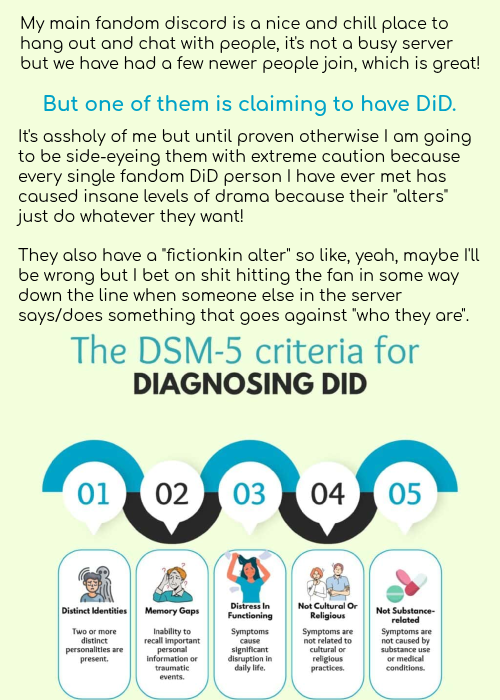
(Anonymous) 2026-04-18 01:24 am (UTC)(link)Honestly given those numbers and the amount of people I've run into who are open about having DID, there have gotta be more people who have it and aren't open about it, than people who are faking having it.
(Sources for numbers: https://www.ncbi.nlm.nih.gov/books/NBK568768/, https://www.sheppardpratt.org/knowledge-center/condition/dissociative-identity-disorder-did/)
no subject
(Anonymous) 2026-04-18 01:50 am (UTC)(link)no subject
(Anonymous) 2026-04-18 02:33 am (UTC)(link)no subject
(Anonymous) 2026-04-18 03:18 pm (UTC)(link)2. https://www.ncbi.nlm.nih.gov/books/NBK568768/, https://www.sheppardpratt.org/knowledge-center/condition/dissociative-identity-disorder-did
Another article talking about whether it's actually real at all. It's a hotly contested diagnosis because it's so hard to get a reliable sample size to actually work off of, and there's all kinds of social contextual stuff going into it.
It's complicated and hard to study.
no subject
(Anonymous) 2026-04-18 04:11 pm (UTC)(link)The extreme cases that get diagnosed by experts and then debated endlessly are just the tip of the iceberg, like autism when that was newly named and discovered. Lots more people have dissociated identity that does not cause them nearly so much life problems, since it's a compensation disorder in the first place, a somewhat maladaptive way some minds deal with PTSD especially at young ages that then causes greater issues as they get older.
I've known quite a few people with this disorder, which I think would be very unlikely if it was as rare as some claim. 1-3% seems possible but a bit high to me, maybe more like 0.5% would be my guess, but that's pretty random. These are people who had very precarious or horrifying young childhoods, often raised by foster parents or by single parents with severe difficulties of their own, schizophrenia or fast cycling bipolar for example. Often eldest or only children who had difficulty with peers as well.
That kind of isolation and precarity creates an environment where a person can't form a stable identity, so sometimes, they just end up with more than one.
I don't have it myself, but one of my two life partners has it, and I've met three people online with it for real, and I know in person two more. These aren't kids, they're people in their thirties to seventies who have overcome a lot to get to a stable position in life. They don't have any "fictive" identities, and they don't "age regress" visibly, none of this stuff.
But they can't remember (for the most part) their young childhood, or even most of elementary school age, it's part of some hidden/lost younger self that they no longer have access to. They clearly lose track of everything that's going on around them on some occasions and start guessing/pretending they know (sometimes it's funny, sometimes it's impressive). I am going to go out on a pretty sturdy limb and say that a person doing this for 20 years consistently would be a nearly insane level of committing to the bit, so if they don't have DID they have some kind of OCD that makes them pretend to? Occam's Razor and I just am going to go with they really are on whatever DID spectrum may exist, whether or not they qualify with the DSV or whatever the initialism is for that diagnostic manual.
The identities form themselves out of memories. I suppose if the person read a book as a young child in the middle of the situation that caused the dissociation, one of the identities might be that of a character in that book, or a tv show they were watching at that time, but it won't be a current read or watch. Honestly these teen behaviors do sound like bs and roleplaying to make up for some emotional issues? That's just not what people living with the condition act like in my experience. Or maybe it's just their ages ("body" ages lol).